
Celebrating Our Fifth Birthday in March
Enterprise Transformation Advisory · Johannesburg, South Africa
The person you brief is the person
who does the work.
Twenty-five years. Three Tier 1 institutions. R20.4 billion in documented outcomes. One practitioner — embedded, accountable, and present until the job is done.
R20.4bn+
Value Delivered
25+
Years in BFSI
19
Countries Governed
90–180
Days to Stability

Years
About the sherpa
the sherpa is not a consultancy.
It is a structural intervention.
We are engaged by large organisations when strategy is clear but outcomes are not materialising. We work at the structural layer — where authority, decision rights, and accountability determine whether transformation lands or stalls.
Our founder brings over 25 years of experience in financial services transformation at Standard Bank, Nedbank, and Absa CIB — navigating complex, change-resistant environments where most advisors don't last.
By the Numbers
25+ years.
Six sectors.
Four continents.
R20.4bn+
Cumulative value of programmes advised and recovered
30+
Major transformation initiatives influenced across public and private sectors
8–15
Distressed programmes recovered and returned to delivery
10+
Enterprise governance frameworks redesigned at Board and ExCo level
19
Countries across four continents with active mandates
90–180 days
Average time to restore delivery stability in stalled programmes
Board & C-Suite
Primary engagement level — direct access, no intermediaries
What We Do
Six core capabilities.
One structural focus.
Every engagement works at the layer beneath the programme — diagnosing why execution is failing and fixing the conditions that make delivery possible.
01
Enterprise Architecture
Gartner World-Class · TOGAF
We design the structural conditions for large-scale transformation — clarifying authority, accelerating decision velocity, and creating the organisational conditions under which delivery becomes inevitable.
- Architecture governance frameworks and review boards
- Legacy modernisation and cloud migration strategy
- API-first and microservices architecture
- Technology portfolio rationalisation
02
Target Operating Model
R5.4bn Delivered · Nedbank
This is not an org chart exercise. It is a fundamental reconfiguration of how work flows, where decisions are made, and how accountability is distributed across the enterprise.
- Current-state diagnostic and stakeholder mapping
- Future-state design anchored to strategic objectives
- Shared services optimisation
- Benefits realisation tracking and governance
03
Programme Recovery
90–180 Day Stabilisation
When a programme has stalled, missed critical milestones, or lost executive confidence, we diagnose the structural root cause and restore delivery momentum — not by adding governance, but by removing what is blocking it.
- Structural root cause diagnosis — not symptom management
- Backlog rationalisation and delivery reset
- Agile-at-scale implementation (SAFe)
- Stakeholder confidence restoration
04
AI Governance
Board-Ready Frameworks
Boards are approving AI strategies they cannot interrogate. We design AI governance frameworks that are operational, not theoretical — built for regulated environments where explainability, accountability, and audit trails are non-negotiable.
- AI risk taxonomy mapped to King IV, Basel, COBIT
- Board and ExCo reporting in fiduciary language
- Algorithmic accountability structures
- AI steering committee design and terms of reference
- Model risk governance integrated into second line
05
Risk & Resilience
Multi-Jurisdictional · 19 Countries
We build operational resilience into the organisational fabric — ensuring continuity under crisis conditions. Our governance frameworks have operated across 19 countries under King III/IV, Basel III, IFRS 9, and SARB requirements.
- IT GRC framework design and implementation
- King III/IV and Basel III compliance architecture
- Business continuity and crisis management design
- Multi-jurisdictional regulatory compliance
06
Implementation
Embed · Execute · Transfer
We do not stop at design. We embed, co-execute, transfer knowledge, and ensure institutional permanence. The difference between a strategy document and a structural change is execution — and that is what we stay for.
- Fractional CTO / Programme Director
- Agile centre of excellence establishment
- Digital talent development programmes
- Change adoption and capability transfer
Ready to engage?
Your transformation is stalling
for a structural reason.
We find it. We fix it. No intermediaries.
Our Edge
We diagnose root causes.
Not symptoms.
Over two decades working inside complex financial services transformations, compliance-driven environments, and change-resistant institutions has produced one consistent insight: failure is almost never the methodology. It is always the people — and the structural conditions that allow the wrong behaviours to persist unchallenged.
We don't add governance.
We remove governance theatre.
Most advisors respond to delivery failure by adding oversight layers. We diagnose why delivery is failing and eliminate the structural blockages preventing progress.
We don't push harder in broken systems.
We redesign the system itself.
Forcing activity inside a dysfunctional operating model produces exhaustion, not outcomes. We fix the model so that effort translates directly into delivery.
We don't send reports.
We deliver execution-ready frameworks.
Our outputs are designed for immediate implementation — not to be filed, presented, or deferred to the next steering committee.
We don't use intermediaries.
You engage us directly.
No account managers. No junior consultants. The person you brief is the person who does the work.
We don't sell half a solution.
We don't engineer the next engagement.
Our mandate is resolution, not retention. Every engagement is scoped to be complete — because a client who doesn't need to come back is the only referral worth having.
“The most underdiagnosed risk in any transformation is the tenured manager with eighteen months to retirement. They will not sabotage the programme. They will simply outlast it.”
— the sherpa
Our Entry Pattern
Every engagement follows
the same structural logic.
W1–4
Diagnose
Structural diagnosis. Stakeholder mapping. Power structure audit. Identify the real blocker — not the stated one.
W5–8
Intervene
Structural intervention. Governance reset. First visible win secured. Delivery momentum restored.
W9–12
Embed
Embed the change. Transfer capability. Ensure it holds when the sherpa leaves.
Proof
Mandates delivered.
Outcomes documented.
Anonymised for client confidentiality. Metrics are auditable and available to qualifying organisations on request.
Tier 1 Retail & Investment Bank · South Africa
Operating Model Transformation at Scale
The organisation's operating model had not kept pace with its digital ambitions. Shared services were fragmented, decision rights were unclear, and transformation initiatives were consuming budget without producing structural change.
R5.4bn
Cumulative TOM benefits across two programme cycles
18,000+
Employees enabled for remote operations during COVID-19 — zero service disruption
R380m
Projected annual savings from contingent workforce optimisation
30%
Reduction in time-to-hire across contract workforce
Corporate & Investment Bank · South Africa
Credit Programme Recovery
A Basel III / IFRS 9 compliant credit system programme had spent over twelve months in analysis with no build progress. A backlog of 400+ unmanaged items, two stalled scrum teams, and collapsed stakeholder confidence.
35%
Credit decision processing efficiency — cycle reduced from 45 to 15 minutes
62.5%
Backlog reduction — 400+ items rationalised to 150 prioritised items
85%
Programme Increment commitment achievement — restored within 2 PI cycles
40%
System availability improvement through batch run optimisation
Tier 1 Banking Group · Architecture Function
Architecture Elevation to Board-Reporting Capability
The architecture function was perceived as a technical cost centre. It had no strategic mandate, no board visibility, and no measurable influence on the organisation's R9bn technology modernisation programme.
World-Class
Gartner/CEB architecture rating — first SA financial institution to achieve this
R9bn
Managed Evolution Programme governed — API-first cloud-enabled core banking modernisation
Board
Architecture elevated from technical function to board-reporting strategic capability
Multinational Banking Group · 19-Country Scope
IT Governance & Compliance Framework — Built from Zero
King III governance requirements demanded a functional IT GRC capability that did not exist. The organisation operated across 19 countries with no unified framework, inconsistent controls, and significant regulatory exposure.
19
Countries brought under a unified IT governance framework
Section 11D
Income Tax Act amendment — authored BASA position paper enabling R&D tax incentives for financial services
R1.5bn
One IT Programme benefits delivered through infrastructure unification
Pioneer
First IT GRC function established at this institution — frameworks remain in use
All case studies are anonymised. Institutional names available to qualifying organisations under NDA.
Insights
What twenty-five years
actually teaches you.
Featured · Latest Thinking
Your Programme Isn't Failing. Your Governance Is.
Most stalled transformations are not methodology problems — they are accountability vacuums. The steering committee meets, the status report is green, and nothing moves.
Governance · Read Article →02
Why Agile Fails in Banks — And What Actually Fixes It
Agile was designed for product teams with autonomy. Banks are compliance-first, hierarchy-deep, and audit-conscious. The collision produces ceremony without delivery.
Agile · Delivery03
The Tenured Manager With Eighteen Months to Retirement
The most underdiagnosed transformation risk is not resistance — it is strategic patience used as sabotage.
Change Management04
What R20bn in Transformation Taught Me About Operating Models
Organisations redesign their org chart and call it an operating model. They are not the same thing. That distinction costs billions when it is missed.
Operating Model05
The 90-Day Diagnostic — What I Do First When a Programme Is Stalling
The first four weeks are not about fixing anything. They are about understanding who actually controls what — which is almost never what the org chart says.
Methodology06
Boards Are Approving AI Strategies They Cannot Interrogate
The gap between AI deployment and AI governance in financial services is widening faster than most risk functions can absorb.
AI GovernanceThe Original Sherpa
ZAR 20.4bn+
Delivered
25+ Years
Experience
19 Countries
4 Continents
Idris (Darren) Sutcliffe van Dyk
Founder & MD — The Original Sherpa
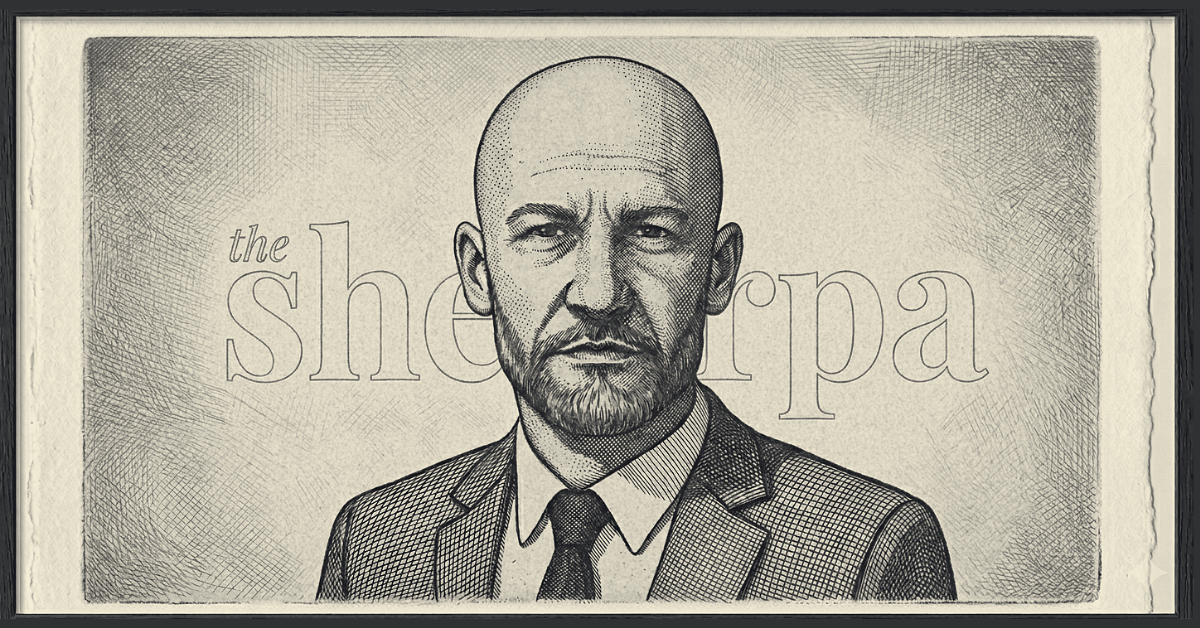
Battle-scarred and field-tested, Idris Sutcliffe van Dyk is a pre-eminent transformation executive with a 25-year track record of orchestrating enterprise-wide digital and operational change. Having operated within Africa's premier financial institutions — including Standard Bank Group, Nedbank Group, and Absa Corporate & Investment Banking (CIB) — he specialises in entering unstable or immature systems to impose the structural coherence and governance required to restore predictability. To date, his mandates have architected and delivered more than ZAR 20.4 billion in documented transformation outcomes.
The Governance Instinct
Idris's path to the boardroom was intentionally unconventional. As the godson of an MK cadre, he developed a “governance instinct” shaped by the high-stakes machinations of public service and political activism. Serving as Chief of Staff in the Gauteng Legislature, he mastered the art of navigating institutional power dynamics and legislative complexity — a unique “political intelligence” he later translated into the corporate arena to manage multi-jurisdictional volatility and regulatory headwinds.
Strategic Impact and Scale
His executive career is defined by the successful delivery of “impossible” mandates. At Nedbank Group, as Digital Transformation Executive, Idris was a primary architect of the Group's Target Operating Model (TOM), which yielded ZAR 5.4 billion in audited benefits. Notably, his leadership during the COVID-19 pandemic ensured seamless operational continuity for 18,000 employees transitioning to remote work — setting a benchmark for crisis resilience in the South African banking sector.
Prior to this, as Enterprise Architecture Executive, he transformed Nedbank's Architecture Office into a board-reporting function that achieved a ‘World-Class’ rating from Gartner — the only South African financial institution to receive the distinction at that time.
His capacity for high-level diplomacy was further proven during his tenure as General Manager of the ICBC Strategic Cooperation in Beijing, where he facilitated the largest foreign direct investment deal in South African history.
The Sherpa Methodology
In 2021, Idris founded The Sherpa (formerly Corporate Sherpa Consulting) to bridge the persistent gap between enterprise strategy and pragmatic execution. His approach rejects traditional consultant dependency in favour of capability transfer and institutional permanence. A specialist in Agile-at-scale (SAFe), Enterprise Architecture (TOGAF), and IT Governance (COBIT/King IV), Idris integrates these often-siloed disciplines into a single, cohesive execution mandate.
Values-Led Leadership
A Muslim (reverted October 2025), Idris anchors his professional practice in the principles of amanah (trust), adl (justice), and ihsan (excellence).
This ethical framework, combined with his conversational Mandarin and deep experience in emerging markets, positions him as a unique bridge between African, Asian, and GCC economic interests. He remains a committed advocate for structural inclusion and is currently focused on senior executive mandates and board advisory roles that require a combination of architectural rigour and “field-tested” leadership.
Questions
Straight answers.
We do not produce reports for steering committees. We do not add governance layers. We work at the structural layer beneath programmes — diagnosing why delivery is failing and fixing the conditions that make execution possible. You engage us directly, with no intermediaries. Every engagement is scoped to close, not to continue.
Ready to Engage?
Are your efforts stalling
for a structural reason?
We find it. We fix it. No intermediaries.
Start the ConversationEngage Us
Most transformation problems are solvable.
Few are being solved correctly.
We are selective. Deliberately. The sherpa takes a limited number of mandates at any time — not as scarcity theatre, but because the person you brief is the person who does the work, and that work deserves full attention.
If your programme is stalling, your governance is producing reports instead of decisions, or your operating model is absorbing effort without producing outcomes — you have a structural problem. That is what we fix.
Before You Reach Out
This is who we work best with:
Organisations with 500+ employees undergoing structural transformation, operating model redesign, or programme recovery
Executives who have already tried the large consultancy and are looking for something that actually lands
Leaders who want a diagnosis, not a deck
Situations where the real problem and the stated problem are not the same thing
One conversation. No pitch. No obligation. We will tell you within 48 hours whether we can help — and if we cannot, we will tell you who can.
The person you contact is the person who does the work.